
Haworth Parsonage

In North Yorkshire, on the outskirts of Keighley near Bradford, nestling on a hillside between Penistone Hill and the Worth Valley, is the quaint country town of Haworth. Its gift shops and cafés, clinging to the steep cobbled main street, mask the town's past as a centre of industry. It once was, as the town's website describes it, "polluted, smelly and wretchedly unhygienic." At the top of the hill is St Michael and All Angels church, where in 1820 Patrick Brontë was appointed curate. His duties would have included ministering to the poor and the sick, and Haworth had plenty of both. Average life expectancy was 26, and 41% of children died before their sixth birthday. You can get a feeling for this just by looking around the churchyard. It's jam-packed (standing room only, I would say), estimated to contain 42,000 graves, some of which held entire families. Patrick Brontë was constantly campaigning for it to be improved, cleaned, and renovated. Death in a northern industrial town was ever-present and a frequent visitor to the Brontë household.
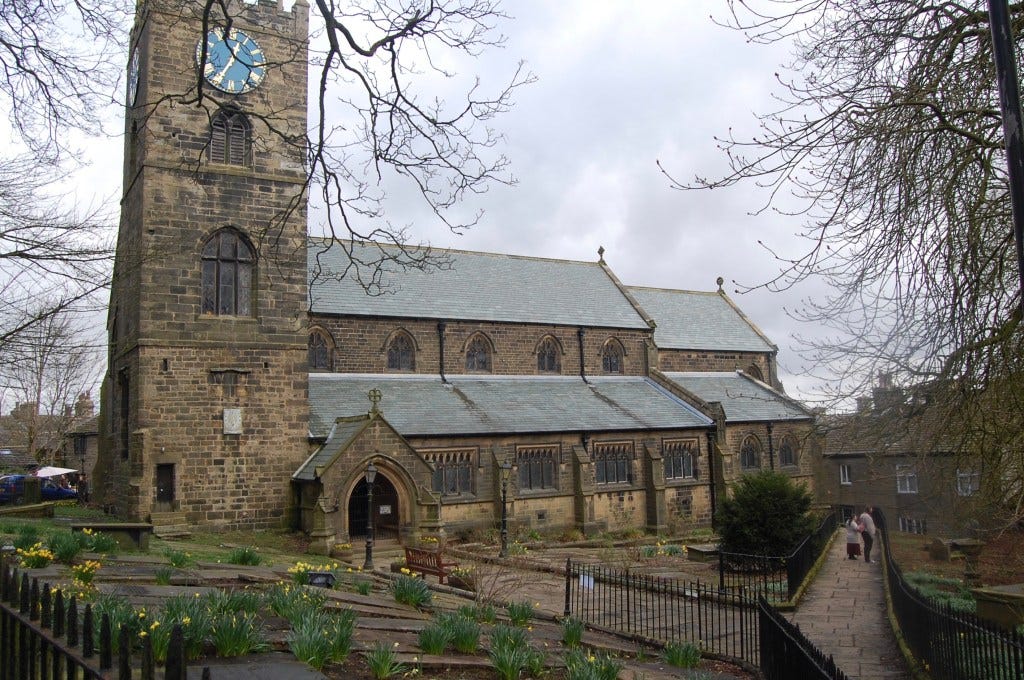
Into the modest parsonage to the west of the churchyard were squeezed Patrick, his wife Maria and their six children: Maria (7), Elizabeth (5), Charlotte (4), Patrick Branwell (3), Emily (2), and the infant Anne. Five years later the family was reduced by three; by 1855 only Patrick remained. He lived on to the ripe old age of 84 but had to endure the deaths of his entire family. The parsonage is preserved by the Brontë Society as a delightful little museum. The entrance fee is modest, and you get a lot for your money. The house itself is decorated in keeping with the period in which the sisters inhabited it, using letters and diary entries from Charlotte and her friends and associates, including Elizabeth Gaskell. The exhibits link each room with specific family members, and you can see the dining room in which Charlotte, Emily, and Anne wrote some of the greatest novels in English literature.
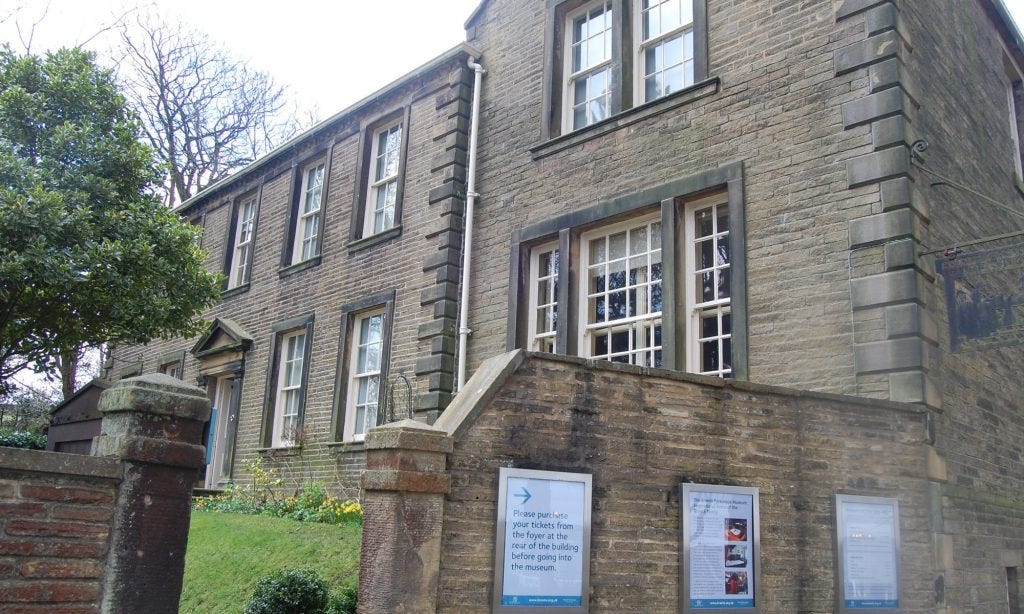
There are also two exhibition rooms. One houses a permanent exhibit of objects associated with the Brontës and Haworth. I found the tiny little books they wrote as children particularly interesting: they created fantasy worlds with their own history, myths, and legends, all recorded in tiny handmade books. There are some of Branwell's paintings (his famous portrait of his sisters hangs on the stairway) and a large collection of what has become known as "Brontëana." This collection of personal possessions and artefacts was dispersed—bought or otherwise acquired by Brontë collectors. The Brontë Society has been returning it to the museum since 1928. There is also a temporary exhibition containing works by local artists as well as pieces inspired by the Brontë novels. Before leaving the house you will be ushered through the bookshop, which is among the finest I have visited. When running a gift shop in a historic house, it must be tempting to fill the shelves with piles of cheap tat. I am happy to say that the Brontë Society has resisted this temptation. There are beautiful editions of all the novels and poems; you will find one to suit your pocket. There are reproductions of Charlotte's drawings along with gifts and products inspired by them.
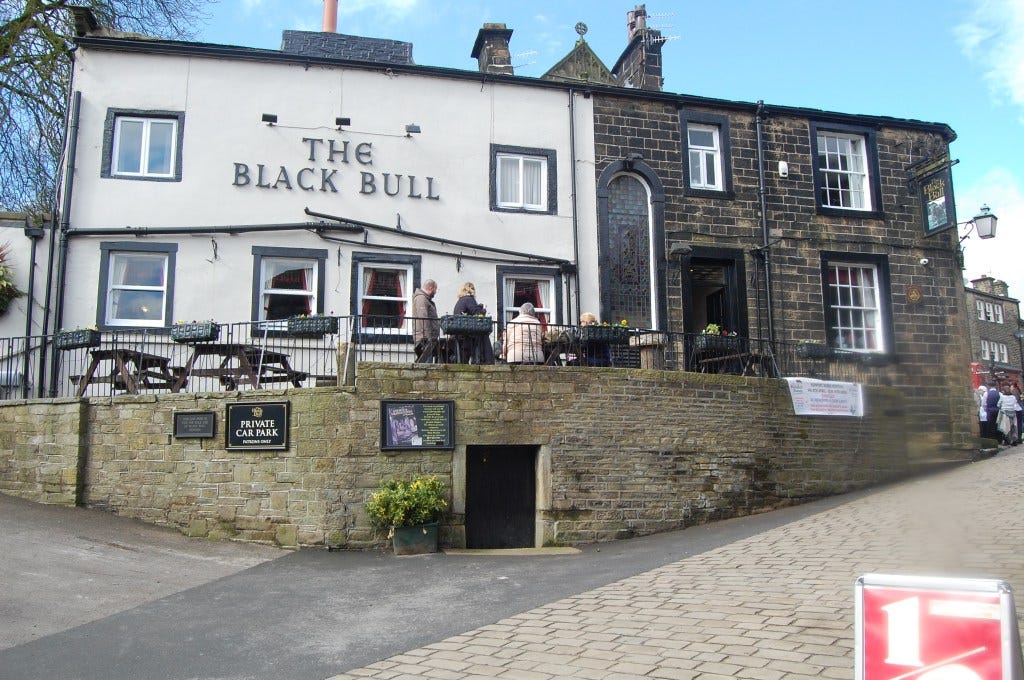
Elsewhere in the town there are many other places of interest. You can visit the family's graves (except Anne; she requested to go to Scarborough when she became ill) in the church. You can get a very good lunch at the Black Bull, the pub where the ne'er-do-well Branwell spent much of his time. You can also visit the apothecary where he bought his laudanum (don't ask to buy any: although the shopkeeper laughed politely, her expression told me she gets asked this question at least a hundred times a day in high season). This is now a fantastic little shop selling handmade toiletries and beauty products, along with "bathroom curiosities": old-fashioned shaving equipment and the like. The smell of the place is amazing. Mrs. P. and I lunched in a small café called Cobbles and Clay, which also houses a pottery studio. It was lovely. We had a Yorkshire Platter: a board heaving under the weight of rustic bread, ham, cheese, and pickles. We do love a sharing board, Mrs. P. and I.
I have relatively recently become a fan of the Brontë sisters. Although I read Wuthering Heights and Jane Eyre when I was younger, they confused me. The stories seemed disjointed and uneven, some of the characters unattractive, and the landscapes were described in a way I wasn't used to from other early Victorian literature (much of which is more heavily influenced by the Romantic era). I now see that it is the unusual construction that makes the novels so compelling. If you haven't already, I strongly urge you to read these two novels. I'm never sure which is the better; I change my mind after every rereading. These two books stand head and shoulders above the rest of the canon. The landscape features strongly throughout the stories: episodes that take place on the moors are at the heart of both of them, and to appreciate them properly you should spend some time wandering the moorland. There are a number of influential places within walking distance: Ponden Hall, Wycoller Manor (the model for Ferndean in Jane Eyre), and Top Withens. Top Withens was never the model for Wuthering Heights, but it has become inextricably bound to it.
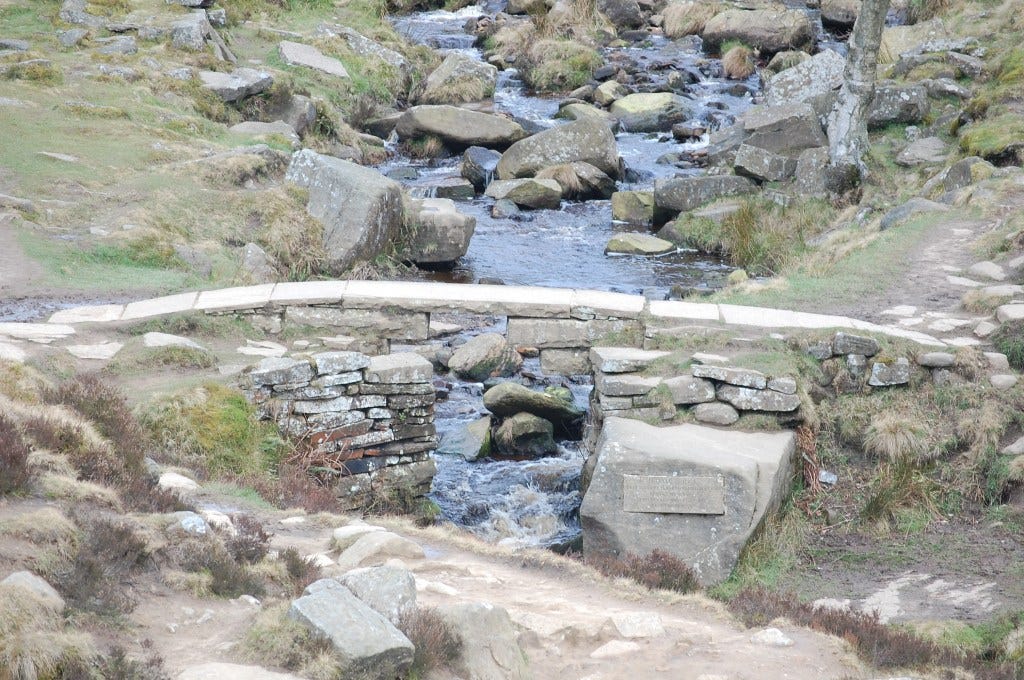
Top Withens is about four miles out of Haworth, across the moors, so it was to this destination I planned to walk. It was a beautiful, sunny spring afternoon when I set out to appreciate the atmospheric ruins, which would, no doubt, shimmer in the late-afternoon sunshine; I would perch on a nearby boulder, shield my eyes from the glare, and spend a lazy hour sunning myself and taking in the ambience. This was Yorkshire, however, so ten minutes into my walk I was soaked to the bone, knee-deep in mud, and shivering with cold. The path was well defined, though I was forced to leave it at one point by a particularly aggressive sheep. He stared me out. I made it as far as the falls (about halfway) before I gave up. The Brontë Falls are beautiful; they cascade down the hillside into a brook, where there is a lovely stone bridge to cross if you continue the journey. Nearby is a chair-shaped rock in which the sisters are supposed to have taken turns to sit and tell stories. There is a circular walk across the moors that takes three days to complete, and I hope to undertake it one day.
If you’re now in the mood for investigating the lives of young women writers who died far too young, Sylvia Plath’s grave is in Heptonstall, near Hebden Bridge. You can also stay in Ted Hughes’s childhood home in Mytholmroyd, which is now a holiday home. You should also try to visit the Brontës’ birthplace in Thornton, Bradford. All of these are a short drive or a long walk from Haworth. You should also take a ride on the Keighley and Worth Valley Railway, which stops at Haworth Station and was used for the classic film The Railway Children. If you are a fan (of the film or just of Jenny Agutter) you should definitely give it a visit.
There are some really good online resources for Haworth and Yorkshire: start with the excellent Brontë Society website.
Been a while since I walked around the place
Thank you for posting this. So interesting.